Research
Computational imaging
My long-term vision is to advance the computational foundations of next-generation imaging systems. By integrating mathematical structure, imaging physics, and data-driven learning, I develop methods to expand imaging capabilities. I am particularly interested in recovering rich spatial, temporal, and quantitative information from indirect, incomplete, and noisy measurements to push the limits of what can be resolved, tracked, and quantified.
Toward this vision, my research is organized around three connected themes: numerical methods for large-scale inverse problems, physics + learning for reliable reconstruction, and biomedical & scientific imaging for understanding complex biological and physical systems. Together, these themes bridge fundamental advances in mathematics and computation with real-world imaging challenges, pushing the boundaries of imaging capabilities and enabling new scientific discoveries and biomedical applications.

Exploiting mathematical structure for efficient large-scale computation.
Combining physical models with data-driven learning for reliable reconstruction.
Extracting meaningful information from complex measurements.
Numerical Methods
Exploiting mathematical structure for efficient large-scale computation.
Modern inverse problems often involve high-dimensional variables, nonlinear forward models, incomplete data, and complex physical models, posing fundamental challenges in both computation and reliability. My research develops numerical methods that exploit mathematical and problem structure to address these challenges efficiently and reliably.
My work draws broadly on numerical analysis, scientific computing, and optimization. A recurring principle is to identify exploitable structure—across scales, curvature, low-dimensional representations, or forward models—and incorporate it directly into algorithm design. This perspective enables efficient computation for inverse problems that would otherwise be prohibitively expensive to solve.
Focus areas
- Multigrid and multilevel methods
- Quasi-Newton and proximal methods
- Krylov-subspace methods and preconditioning
- Stochastic and mini-batch optimization
- Acceleration and extrapolation methods
Related publications
- [1] T. Hong, U. Villa, and J. A. Fessler, “A Convergent Generalized Krylov Subspace Method for Compressed Sensing MRI Reconstruction with Gradient-Driven Denoisers,” IEEE Transactions on Computational Imaging, vol. 12, pp. 378–390, Jan. 2026.
- [2] T. Hong, T.-an Pham, I. Yavneh, and M. Unser, “A Mini-Batch Quasi-Newton Proximal Method for Constrained Total-Variation Nonlinear Image Reconstruction,” SIAM Journal on Imaging Sciences, vol. 19, no. 3, pp. 1864–1894, 2026.
- [3] T. Hong, Z. Xu, J. Hu, and J. A. Fessler, “Using Randomized Nyström Preconditioners to Accelerate Variational Image Reconstruction,” IEEE Transactions on Computational Imaging, vol. 11, pp. 1630–1643, Oct. 2025.
- [4] T. Hong and I. Yavneh, “On Adapting Nesterov’s Scheme to Accelerate Iterative Methods for Linear Problems,” Numerical Linear Algebra with Applications, vol. 29, no. 2, p. e2417, 2022.
- [5] T. Hong, I. Yavneh, and M. Zibulevsky, “Merging Multigrid Optimization with SESOP.” 2018. Available at: https://arxiv.org/abs/1812.06896
Physics + Learning for Computational Imaging
Combining physical models with data-driven learning for reliable reconstruction.
Computational imaging provides explicit knowledge of how measurements are physically generated, while data-driven learning can capture complex image structure from data. My research brings these complementary sources of information together within model-based reconstruction.
I am particularly interested in integrating learning with physical forward models, using learned priors, denoisers, and other data-driven representations to model image structure that is difficult to characterize explicitly. This integration allows learned information to guide reconstruction while maintaining consistency with the measurements and underlying imaging physics.
Focus areas
- Learned priors
- Physics-integrated iterative reconstruction
- Convergence and reliability of learning-based methods
Related publications
- [1] T. Hong, U. Villa, and J. A. Fessler, “A Convergent Generalized Krylov Subspace Method for Compressed Sensing MRI Reconstruction with Gradient-Driven Denoisers,” IEEE Transactions on Computational Imaging, vol. 12, pp. 378–390, Jan. 2026.
- [2] T. Hong, Z. Xu, S. Y. Chun, L. Hernandez-Garcia, and J. A. Fessler, “Convergent Complex Quasi-Newton Proximal Methods for Gradient-Driven Denoisers in Compressed Sensing MRI Reconstruction,” IEEE Transactions on Computational Imaging, vol. 11, pp. 1534–1547, Oct. 2025.
- [3] T. Hong, X. Xu, J. Hu, and J. A. Fessler, “Provable Preconditioned Plug-and-Play Approach for Compressed Sensing MRI Reconstruction,” IEEE Transactions on Computational Imaging, vol. 10, pp. 1476–1488, Oct. 2024.
- [4] T. Hong, I. Yavneh, and M. Zibulevsky, “Solving RED with Weighted Proximal Methods,” IEEE Signal Processing Letters, vol. 27, pp. 501–505, Mar. 2020.
Biomedical & Scientific Imaging
Extracting meaningful information from complex measurements across MRI, photoacoustic, and optical imaging.
Biomedical and scientific imaging increasingly aim to recover information that is not directly accessible from measurements, ranging from high-resolution anatomical structures to dynamic processes and quantitative properties. My research develops computational imaging methods that expand what can be resolved, tracked, and quantified from limited and imperfect measurements.
I work across magnetic resonance imaging, photoacoustic, and optical imaging, where different measurement physics give rise to distinct inverse problems and computational challenges. Across these modalities, I am particularly interested in enabling faster and more robust imaging, resolving dynamic processes, and advancing quantitative imaging to better characterize underlying physical and physiological systems.
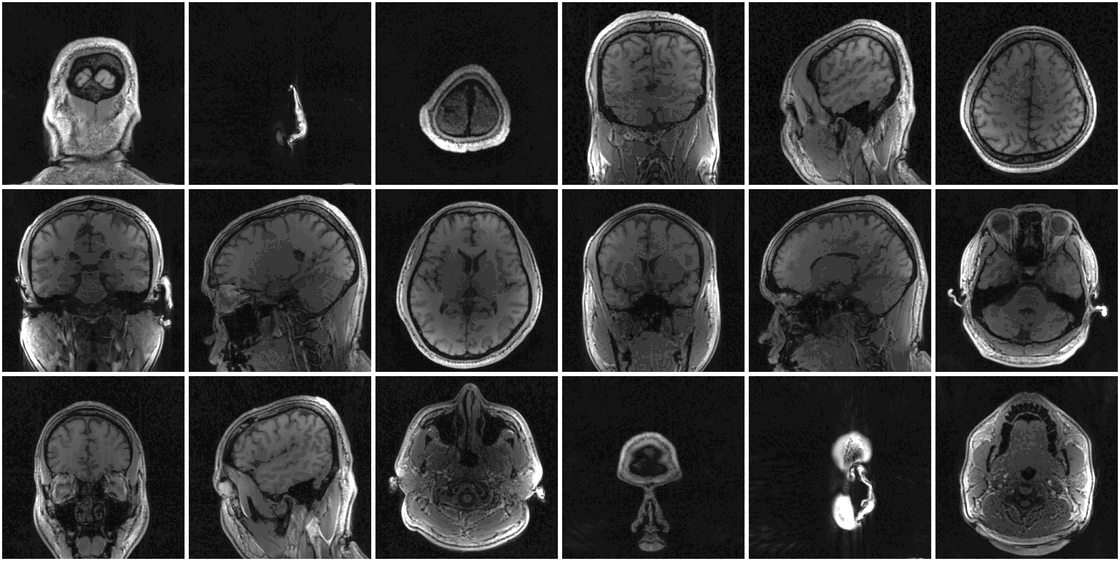
Magnetic Resonance Imaging
- Accelerated and compressed-sensing MRI
- Nonlinear and model-based reconstruction
- Motion-robust reconstruction
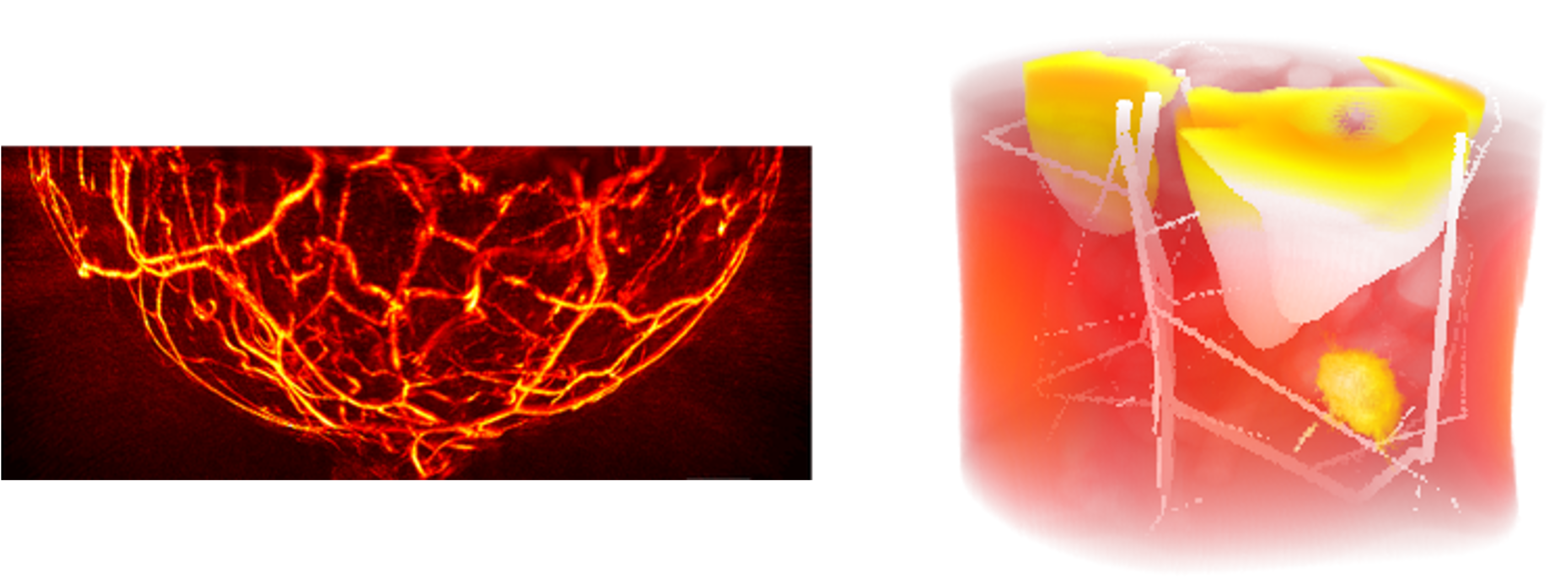
Photoacoustic Imaging
- Dynamic image reconstruction
- Low-dimensional representations of spatiotemporal images
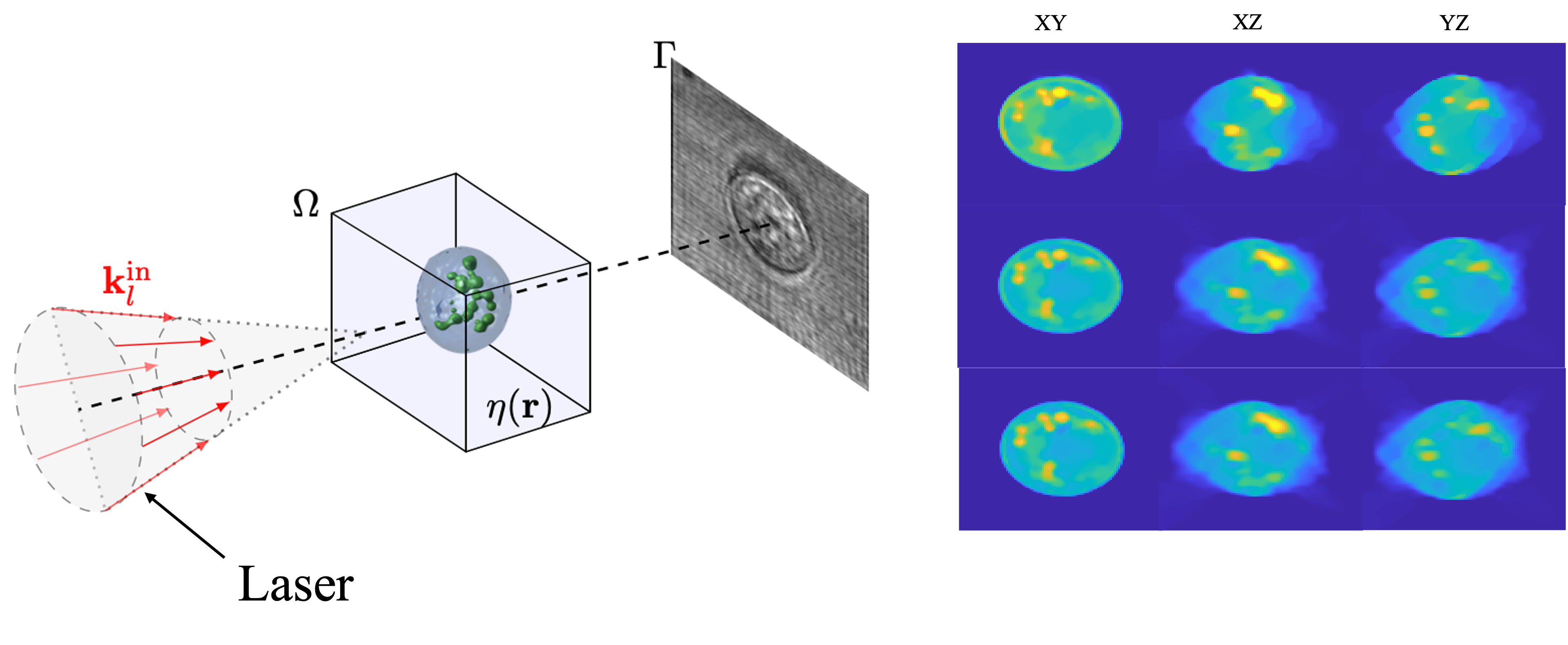
Optical Imaging
- Optical diffraction tomography and Fourier ptychography
- Nonlinear image reconstruction
- Wave-based inverse problems
Related publications
- [1] T. Hong, T.-an Pham, I. Yavneh, and M. Unser, “A Mini-Batch Quasi-Newton Proximal Method for Constrained Total-Variation Nonlinear Image Reconstruction,” SIAM Journal on Imaging Sciences, vol. 19, no. 3, pp. 1864–1894, 2026.
- [2] T. Hong, X. Xu, J. Hu, and J. A. Fessler, “Provable Preconditioned Plug-and-Play Approach for Compressed Sensing MRI Reconstruction,” IEEE Transactions on Computational Imaging, vol. 10, pp. 1476–1488, Oct. 2024.
- [3] T. Hong, J. Shah, L. Lozenski, R. Cam, M. Anastasio, and U. Villa, “A Virtual Imaging Framework for DCE-PACT Estimation of Tumor Perfusion,” in Medical Imaging: Physics of Medical Imaging, SPIE, 2026.
- [4] T. Hong, T.-an Pham, E. Treister, and M. Unser, “Diffraction Tomography with Helmholtz Equation: Efficient and Robust Multigrid-Based Solver.” 2021. Available at: https://arxiv.org/abs/2107.03679
Full list: Publications · Google Scholar